



















Flow Battery
Commons

The open online community for flow battery research. A new approach to communication, knowledge exchange, collaboration, and resource sharing in our research field.

KEEP IT FLOWING
DISCORD GITHUB
92
Members
9
Online now
7
Repositories
8
Followers
Why a digital commons?

Bridging the distance.

As in each academic research field, flow battery research is spread over many academic and industrial research teams world-wide. The flow battery commons exists to bridge this distance: one open online community where flow battery researchers can get in contact and discuss important research questions to advance the research field collectively.

  1. 01

    Connection

    Getting in contact.

    Lower the hurdles to connect to research peers across countries, institutions, and experience levels. It's the first step toward building professional relationships that can lead to fruitful collaborations or even joint projects. It may also help to stay in contact after conferences and meetings.

  2. 02

    Exchange

    Sharing resources.

    Academic research communities consist of swiftly changing groups of individuals. Not all knowledge can be captured in publications or protocols. Providing a place to ask questions and share resources ensures that valuable experiences and tools are not lost as people move along their career paths.

  3. 03

    Cooperation

    Finding collaborators.

    Sometimes you need one specific expertise or piece of equipment that your own lab lacks. An online channel helps you find collaborators for your research projects and experiments, enabling joint efforts that single labs could not accomplish alone.

  4. 04

    Harmonization

    Improving reproducibility.

    Repeatability, reproducibility, and replicability in flow battery research needs to be improved. By a community-driven approach, we can develop best practices in experimentation and data reporting to ensure that results are comparable across different labs.

These aims reflect the core motivations behind the flow battery commons and guide how the community interacts and collaborates. But everyone is welcome to participate and shape this evolving community in their own way.

Community resources

From datasets to software tools.

This community is also about (re)sharing digital resources at a central place, which helps to disseminate knowledge and tools that push our research field forward: from datasets of publications to software tools established by its members.

Datasets

Public datasets from publications are becoming more and more common as FAIR (Findable, Accessible, Interoperable, Reusable) principles are adopted. They enable meta studies and a better understanding of broader trends in flow battery research. We encourage members to (re)share their datasets here at this central place to make them more findable.

Explore the digital resources

Open Hardware

With the cost-efficient access to microcontrollers and 3D printing, more researchers can build custom hardware for their experiments. We encourage your to share your open hardware designs with the community. From 3D-printed flow cells over sensors to custom-built test racks – every contribution might help another researcher or lab advance their work.

Explore the digital resources

Living Documents

Documents that continuously evolve with our collective understanding of this interdisciplinary field. Such documents are updated in a version-controlled, open peer-review and aim at capturing best practices in experimentation and data reporting.

Explore the digital resources

Learning

Important teaching document, tutorials, and educational resources for members to learn and advance their skills in flow battery research. Feel free to share any material that helped you to expand your knowledge and expertise.

Explore the digital resources

Event Materials

Tangible outcomes, protocols, documents, presentation slides, and other digital resources from past events, workshops, and community gatherings related to flow battery research. It may contain everything event organizers and participants are willing to share with the community.

Explore the digital resources

Software Tools

From open-source simulation software to data analysis scripts: Digital tools that foster theoretical understanding and accelerate data exploration can significantly enhance the research capabilities of the community.

Explore the digital resources

The listed digital resources are not a comprehensive inventory of all available tools and datasets. Feel free to share any resource you find valuable for the wider community.

News & Events

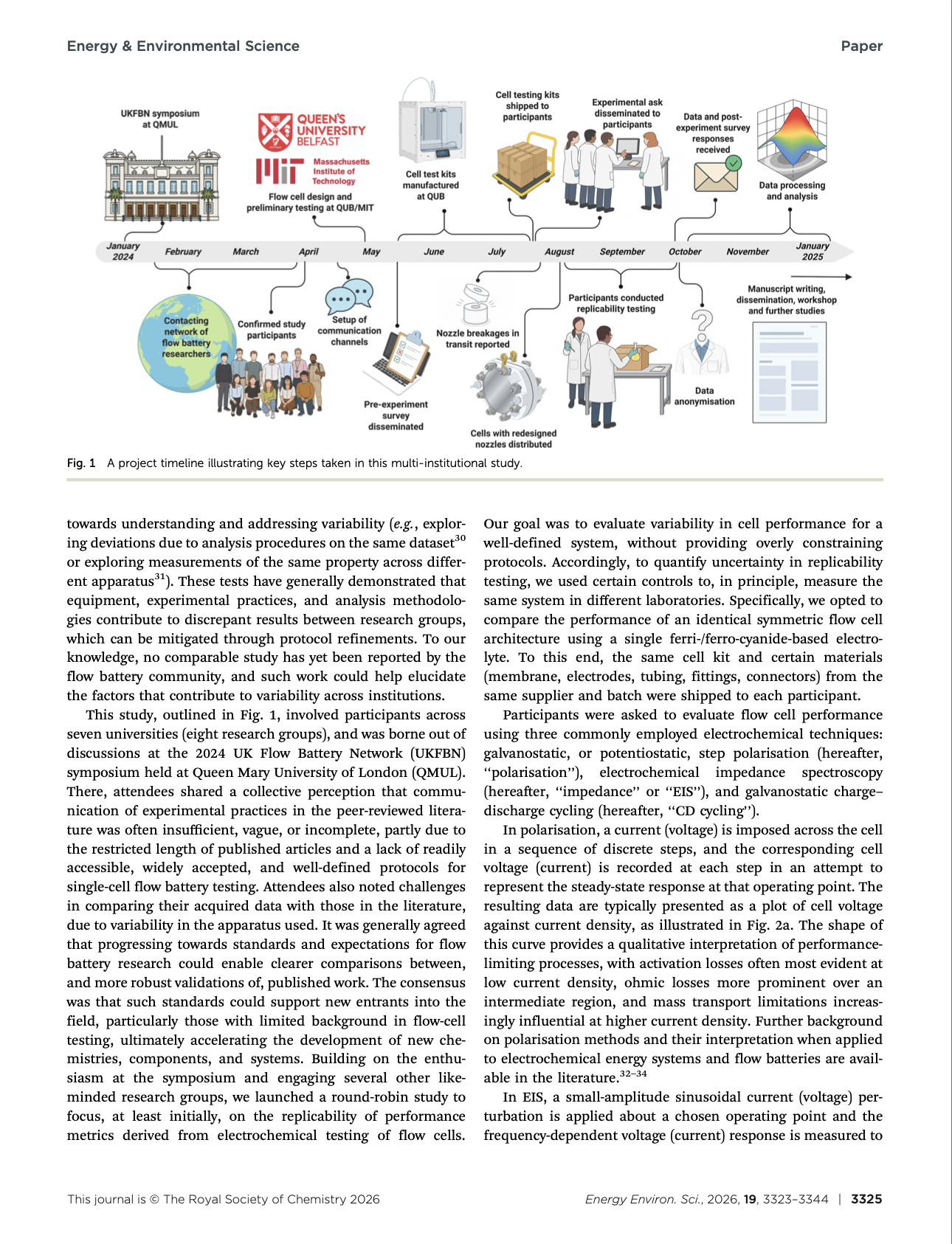
The first page of the paper, with its title, abstract and a figure
Screenshot of Paper © RSC, CC BY 4.0
Publication

Replicability challenges in redox flow cell testing

April 2026 · Energy & Environmental Science, 19, 3323–3344; DOI: 10.1039/D5EE07103H

O'Connor et al. report the results of phase 1 of an international replicability study: a round-robin test in which eight participant groups from seven academic institutions measured the same model flow cell — identical hardware, a well-studied electrolyte, a symmetric cell configuration and the same experimental prompts. Charge–discharge profiles, polarisation curves and Nyquist plots nevertheless differed appreciably between the participating groups. The authors conclude that differences in protocol and data acquisition alone have a clear and non-negligible effect on reported performance metrics, while noting that the number of experiments performed does not yet support attribution to specific causes, and argue for shared protocols, documented standard operating procedures and greater methodological transparency. The paper is published open access under CC BY 4.0.

Read the paper
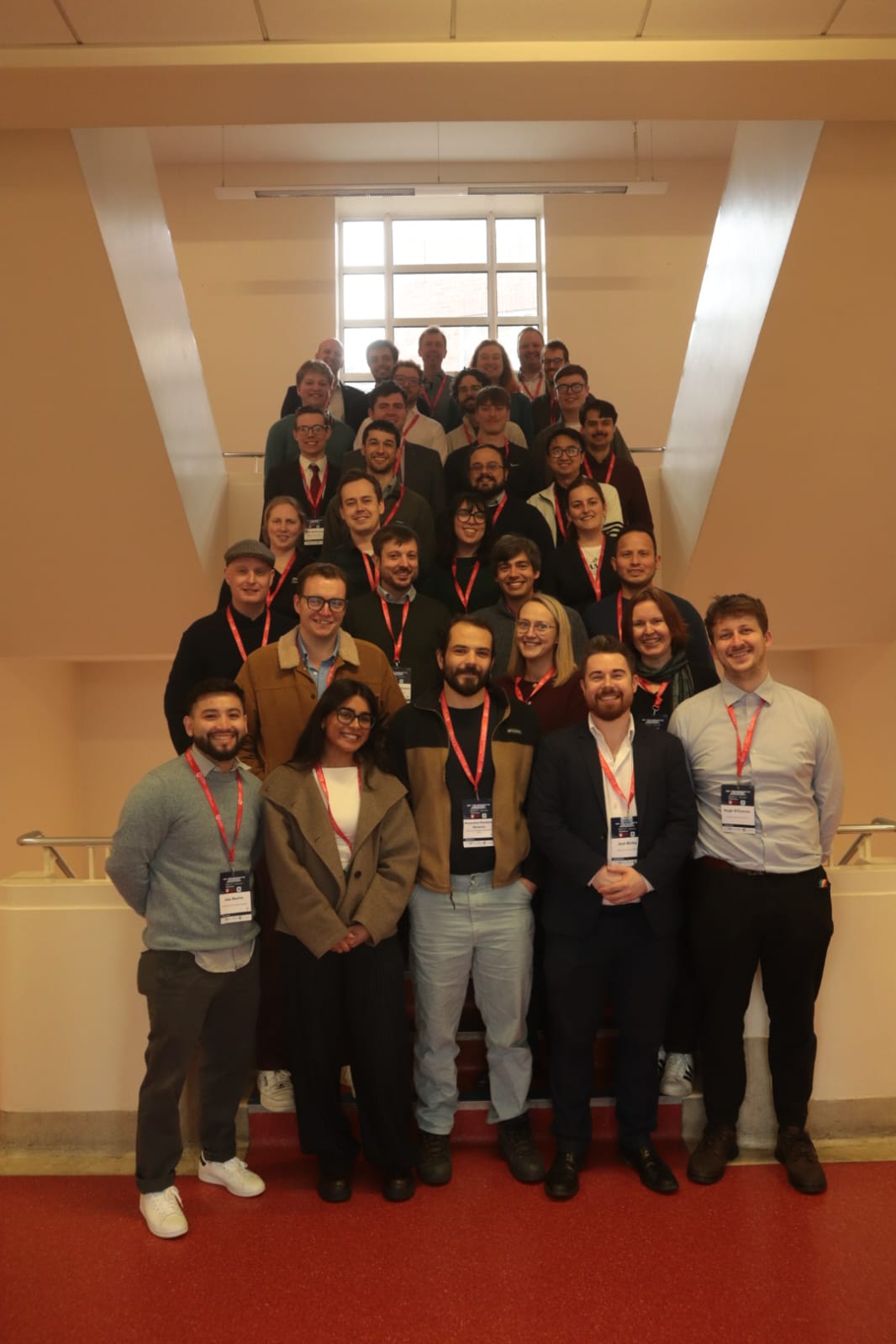
The workshop participants gathered on the staircase of the meeting venue
Photo © Queen's University Belfast
Workshop

First Flow Battery Reproducibility Workshop

March 2026 · Queen's University Belfast

Invited by Josh Bailey and Hugh O'Connor, flow battery researchers from across the globe met at Queen's University Belfast for two days on data reproducibility. The opening day introduced the community's new data infrastructure and its dashboard, alongside sessions from the Physical Sciences Data Infrastructure (PSDI) and the Digital Curation Centre on tools and data curation, and keynotes by Johan Hjelm (DTU) and Jiří Vrána (Pinflow Energy Storage). The second day's four sessions reflected on the interlaboratory studies: shared cell kits, experimental asks, metadata collection and possible follow-on studies. A third phase was sketched around new opportunities for students, refined round-robin experiments and an annual summer school for flow battery assembly and testing. The workshop was funded by PSDI and sponsored by SciMed Ltd and the Royal Society of Chemistry Surface Reactivity and Catalysis Group.

Open the dashboard
FAQ

Frequently asked questions.

Potential questions and/or question commonly asked by new members. If you have any other questions, feel free to reach out to the community on Discord.

Who can join the commons?
Anyone working on flow batteries: academics, engineers, students, professors, and industry people willing to share knowledge. Everyone is welcome as long as they are respectful and interested in flow batteries.
Who is in charge of this online community?
The community was kicked off as part of the international reproducibility study led by researchers from Queen's University Belfast (QUB) and Massachusetts Institute of Technology (MIT). The study and the online community is now coordinated via several voluntary committees: the Community Committee, the Data Infrastructure Committee, and the Research Committee. The Flow Battery Commons is not a legal entity and operates based on the collective efforts of its members.
I'm an undergraduate just starting out — is this a place for me or am I too inexperienced?
This place is exactly for you! The community welcomes members at all stages of their careers, from undergraduates who are just learning what a flow battery is to seasoned researchers and industry professionals. Don't hesitate to ask questions – everyone in the community started at the stage you are now.
I have a question regarding experimental practices. Where should I ask it?
That's simple: Just join the community Discord and ask your question in the appropriate channel. The #forums channel is a good place to start. But don't worry – you can basically ask in any channel and someone will guide you to the right place.
Who can join a committee and how does one do it?
Committee membership is completely voluntary and open to all community members who are interested in contributing. To join a committee, send a message to the #general channel or directly contact the committee chairs. You will then be added to the committee channel and the mailing list so that you can participate in discussions and stay updated on committee activities.
What's the benefit of a GitHub organization? I can store my data in my own GitHub account.
A GitHub organization provides a central home for the community's shared resources such as datasets, code, tools, and documentation. While you can absolutely store all this in your own GitHub account, using an organization repository ensures that the resources are easily findable. Community members simply can come here and explore a single place to find all relevant materials.
How to join this online community

Join the commons

The community uses two online platforms: A Discord server is where the commons talks (e.g. questions, building cooperations, event planning, regular meetings). A GitHub organisation is where our data and resources live.

Feel free to join either or both.